
'A less tense US-China relationship would make Beijing less likely to provoke India -- including on the border -- in retaliation for its close defence ties with the US.'

India and ASEAN have relations "free from contests and claims" and believe in sovereign equality of all nations irrespective of size, and support for free and open pathways of commerce and engagement, Prime Minister Narendra Modi wrote in his column.

United States President Barack Obama and Prime Minister Narendra Modi have made the first use of the secure hotline set up between Washington and New Delhi as they reviewed progress on key areas of cooperation and discussed global issues ahead of the upcoming G-20 summit.
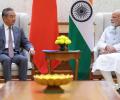
'New Delhi is not naive about its foreign policy choices.'
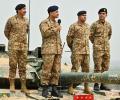
United States President Donald Trump will host Pakistan Army chief Asim Munir for lunch at the White House on Wednesday.
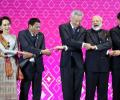
The Modi government has to embrace the history of Tamil conquests in South East Asia and stop obsessing about Babar/Humayun, argues Colonel Anil A Athale (retd).

Prime Minister Narendra Modi's bilateral meetings on the sidelines of the BRICS summit in Johannesburg are being finalised, Foreign Secretary Vinay Kwatra said on Monday but did not give a direct reply on the possibility of a meeting between Modi and Chinese President Xi Jinping.

The stock and bond markets told Trump firmly that any idea of isolating China would lead to harming the US economy and this forced Trump to backtrack, points out Aakar Patel.
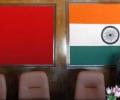
India and China have agreed to take measures to further ease the situation at the borders while continuing to implement the October agreement to resolve the standoff in eastern Ladakh comprehensively. The two sides held the 32nd meeting of the Working Mechanism for Consultation & Coordination on China-India Border Affairs (WMCC) in New Delhi, agreeing to maintain communication through diplomatic and military channels and safeguard sustainable peace and stability in the border areas. This meeting follows the October 21 agreement between the two countries to resolve the over four-year-long military standoff in eastern Ladakh.

Aiming to give fillip to India's Look East policy, Prime Minister Manmohan Singh is expected to announce new initiatives to take forward ties with the ASEAN by setting up a mission and appointing an ambassador for the 10-member grouping.

The closed-door luncheon meeting came amid escalating tensions between Israel and Iran with Trump exploring Washington's possible involvement.

President Biden has been forced to turn his attention to domestic politics, as he works to hash out a deal with Republicans to prevent the US from defaulting on its debts at the end of this month.
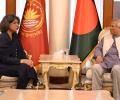
Bangladesh has demanded a public apology and compensation from Pakistan for the 1971 atrocities, raising "historically unresolved issues" during the first foreign secretary-level talks between the two countries in 15 years. Dhaka also asked Islamabad to pay USD 4.3 billion as its share from the combined assets at the time of East Pakistan's split from West Pakistan in 1971 to form an independent Bangladesh.

India on Monday expelled six Canadian diplomats and announced withdrawing its high commissioner and other 'targeted' officials from Canada after strongly dismissing Ottawa's allegations linking the envoy to a probe into the killing of Sikh extremist Hardeep Singh Nijjar, in a major downturn in already frosty ties between the two nations.
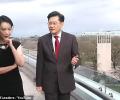
China's Foreign Minister Qin Gang has not been seen in public since June 25. Is he unwell, or has he been purged?
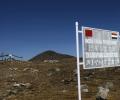
The resolution also pushes back against People's Republic of China (PRC) claims that Arunachal Pradesh is PRC territory, which is a part of the PRC's increasingly aggressive and expansionist policies.
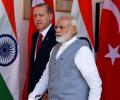
India-Turkiye ties are strained over Ankara's Islamabad tilt, its arms links with Pakistan, and fallout from the Pahalgam terror attack.

A powerful senatorial committee on Wednesday is set to consider a bipartisan resolution to recognise Arunachal Pradesh as an integral part of India, pushing back against China's military aggression to change the status quo along the Line of Actual Control.

Ahead of next month's annual Indo-Russia summit, Prime Minister Narendra Modi on Thursday met Russian Premier Dmitry Medvedev who said India is a "close and valued" partner for his country.

External Affairs Minister S Jaishankar met United States Secretary of State Antony Blinken in Phnom Penh on Sunday and discussed bilateral ties, the raging Ukraine conflict, energy issues, G20 and the situation in the Indo-Pacific, days ahead of a possible meeting between Prime Minister Narendra Modi and President Joe Biden.

The US "Indo-Pacific Strategy" is bound to be a failed strategy, Wang said in the comments posted by the Chinese foreign ministry on its website.

"The bilaterals amidst the multilateral. PM @narendramodi meets Premier Li Kequiang of China for first engagement," External Affairs Ministry Spokesman Vikas Swarup tweeted.

Ukrainian President Volodymyr Zelenskyy told the United Nations Security Council that 'we have to prepare' the second peace summit to end the Russia-Ukraine war 'altogether' and he has invited India and other countries to join the peace process.
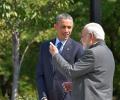
United States President Barack Obama on Thursday praised Prime Minister Narendra Modi's efforts to shake up the "bureaucratic inertia" in India, less than a month after he described the Indian leader as a "man of action".

India and China on Wednesday held 'constructive' and 'forward-looking' diplomatic talks to resolve the over four-year border standoff along the Line of Actual Control (LAC) in eastern Ladakh but there was clear no indication of any breakthrough.
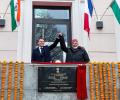
Prime Minister Narendra Modi and French President Emmanuel Macron have called for enhancing trade and investment ties between their countries and committed to further deepening their engagement in the Indo-Pacific. They discussed a full spectrum of bilateral relations, including key global and regional issues, and stressed the urgent need for reform in the United Nations Security Council. The leaders also underscored their commitment to ensuring the global AI sector can drive positive social, economic, and environmental outcomes.

Other world leaders too voiced concern against terrorism and vowed to fight it collectively.

Had India agreed to join the trade pact, Indian markets would have been flooded with cheap Chinese products.

The personal warmth Abbott shared with Modi was reflected yet again at a reception at the iconic 161-year-old Melbourne Cricket Ground (MCG) where he said Modi is like a "brother."
Against the backdrop of growing Chinese assertion in the Asia-Pacific region, India on Thursday said it supports the "freedom of navigation" in international waters noting that any disputes or differences in the region must be resolved diplomatically.

India is no longer shying away from playing a role on the regional and international stages and is willing to don a bigger role in regional politics. It is showing traits of a responsible stakeholder in the regional security dynamics, says Dr Rahul Mishra.

The reception is organised by approximately 90 cultural and community organisations in Malaysia, including expatriates called welcomes partners.

India and China have made "some progress" in disengagement, External Affairs Minister S Jaishankar said on Sunday, describing it as a "welcome" move which opens up the possibility that other steps could happen.

PM Modi proposed a USD one billion line of credit to promote projects that support physical and digital connectivity between India and ASEAN.

India wants more business and closer engagement with ASEAN even as China's influence spreads in the region. Rediff.com's Sheela Bhatt, who is travelling with the prime minister on his visit to Brunei, reports from Bandar Seri Begawan, capital of the tiny oil-rich country.
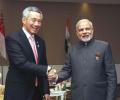
Prime Minister Narendra Modi's visit is an attempt to move the Indo-Singapore relationship to the 'next level'. Singapore has been one of the top investors in India. India-Singapore bilateral trade has already crossed the $15 billion mark. As per the official records, Singapore has emerged as the second largest source of Foreign Direct Investment in India, says Dr Rahul Mishra.
India-Vietnam relationship has its own imperatives and dynamism. In India's look east policy Vietnam has been the major pivot, at least in terms of security and strategic imperatives, says Rup Narayan Das.

'While on the one hand, terrorism continues to be a serious threat to global peace and security, on the other hand, areas such as cyber, maritime and space, are emerging as new theatres of conflict'

"Which foreign powers may be interested in taking advantage of unrest and instability in Manipur? Does the geopolitics of south east Asia also have a role in these events," he asked.

The 'Missing link in India's Act East Policy', as India's former foreign secretary Shyam Saran calls it, needs to be filled sooner rather than later, says Dr Rahul Mishra.
